Many, if not most astrological texts have focused on Aries as the warrior aspect of the goddess. Much is made of Arian stereotypical “bossiness” or unbridled impulsiveness and impatience. Although this Mars energy is definitely an important side to the Aries archetype, it is equally important to remember that Aries is also the archetypal “Kore” or maiden. To get a balanced picture of Aries, we must give equal consideration to both expressions of the Goddess in this sign.
To understand Aries, we must remember its place in the pantheon of the zodiac. Aries is the first of the 12 signs; the sign that heralds spring and the beginning of new life on earth. Images of buds bursting into bloom and of new born lambs frolicking on greening hillsides come to mind.
Aries is Persephone before she becomes Persephone. She is the “Kore”, or, the nameless “every-maiden”. Although nothing comes to us through myth about her life before she is seized by Hades and dragged into the Underworld to embark on what becomes her archetypal descent, we must assume that she did have some semblance of a budding, yet undifferentiated consciousness before. The story of which most of us are familiar, Persephone’s journey into Hades, is the story of the process of her differentiation from nameless maiden to Queen, or in Jungian terms, her individuation.
So, the essential task of Aries the woman, in other words, is the life long task of self–discovery, or individuation. More than any other sign, this is what she has come here to do. The famous self-centeredness of Aries is not so much a lack of concern for others, but the very nucleus or seed of her life’s purpose. The so-called impatience of this sign stems from the impulse to “get on with it”, to fulfill the soul purpose of initiation. Just as spring, when it is time, has decided to come and can be held back by absolutely nothing, so is the Aries spirit when it is in its right skin. As the first sign, Aries is very much eternally youthful, and as such, can be what is construed as impetuous from time to time. However, Aries is a force, like the coming of spring which in its exuberance is virtually unstoppable. This is where the archetypes of the maiden and the warrior converge. There is a deep and mysterious connection between the two, and by meditating on the symbolism of the season of spring itself, will yield rich and startling insights into this, the first of all the signs.
Similarly, in many ways, the Aries archetype can be likened to The Fool in the Tarot. The Fool is usually depicted as a youth stepping trustingly off a cliff with a flower in his hand, his knapsack slung carelessly over his shoulder as he (the Self) unwittingly begins his adventure, or individuation. Although this card is often painted by Tarot artists as a young man beginning his Journey, it could just as easily be the scene in the Elysium field where Kore is picking spring flowers, blissfully unaware of her surroundings, right before Hades comes screaming out of the ground to pull her down to the Underworld where eventually, she becomes Queen.
Tarot symbolism is interesting here. In the Tarot, there are 22 Major Arcana, which relate to 22 major archetypes, or life lessons, that the Self must experience in order to be a fully individuated soul. It begins with the Fool, as we have seen, and ends with the 22nd card, The World. Although there are some overlaps, and most of us do not necessarily experience each of the 22 life lessons in a tidy sequential order, the Tarot provides some valuable insights that are inextricably connected to astrology and Jungian psychology.
Aries as the warrior aspect of the Goddess becomes clear when once again we pay attention to the symbolism of spring. Just as a newborn infant must struggle for its first breath and therefore its very life, in those first few moments after birth; so must spring wrest away the darkness of winter, and with an outward-moving thrust, reclaim the world as a place of new life and burgeoning becoming. In fact, the beginning of life is often fraught with struggle. This is true whether it is the birth of a human baby; a sprout striving to break through the topsoil towards the light; or a cherished project that we are trying to get off the ground. Until recent history, the business of giving birth and being born was not always a certainty. The life of mother or child (and often both) was put to the test, and was something that needed to be fought for. It takes great energy, willpower, and strength of spirit to be born, to make one’s place in the land of the living, and to proclaim boldly, I am here.
In this light, it becomes clearer where Aries has gotten the reputation for being bossy, impulsive or headstrong. It all stems from the primal impulse towards Life, which is the essence of Aries, the archetype. Above all things, Aries is initiation; Life in its most primal form.


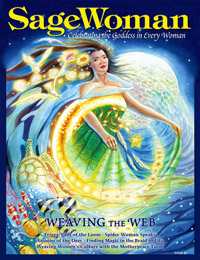 I am also on the edge of my seat waiting for my new column in SageWoman Magazine, which will arrive on the shelves any day now! I feel honored to be part of this magazine, which is celebrating its 25th year in print with this special issue. My column is titled, "Turning the Wheel, Astrology from a Goddess Perspective." Far from a traditional astrological "Sun Sign" column, Turning the Wheel is about learning to align ourselves with the natural rhythms of the seasons, so that as women, we may reclaim our rightful relationship with the earth, and our creative soulful selves.


