Wednesday, November 16, 2011

NEW! Urban Priestess: Danielle Blackwood's Astrology Podcast for November 2011

 
 Now you can listen to the astrological highlights for each month by Astrologer Danielle Blackwood!

This is my first podcast, I hope you enjoy,

Danielle

Monday, October 17, 2011

UrbanPriestess.ca website launches!

Greetings everyone!

I am happy to announce the launch of my new website www.urbanpriestess.ca

Please visit, and I welcome your comments!

Danielle

Saturday, September 24, 2011

Autumn Equinox: The Second Harvest

The wheel of the year continues to turn, and we suddenly find ourselves in the middle of September. The shadows are beginning to grow longer as we face the second half of the year. What are we reaping in our lives? What can we bring to the table after all the work we have done in the passing year?  Although we will surely be bringing in some bountiful crops, there will be some cherished plans and ideals that we will have to allow to die on the vine. 

I am personally thankful this Harvest to see the results of my hard work not only in writing, but for finally breaking through the wall of fear and procrastination to get my work out there!  After much deliberation, I decided to submit a piece to Circle magazine which was published in their Summer issue Sacred Dance.  This was a very difficult decision to make, as it is autobiographical in nature, and more than a little expository.  Because I have gotten so much support and wonderful feedback from the handful of folks that I actually told about this piece, I would like to extend the invitation to any who are interested: It is titled Finding the Sacred within the Profane - under the pen name "Sarah Blackwood". 

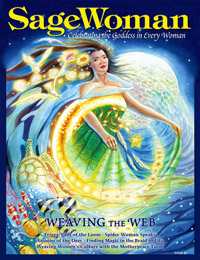
I am also on the edge of my seat waiting for my new column in SageWoman Magazine, which will arrive on the shelves any day now!  I feel honored to be part of this magazine, which is celebrating its 25th year in print with this special issue.  My column is titled, "Turning the Wheel, Astrology from a Goddess Perspective."  Far from a traditional astrological "Sun Sign" column, Turning the Wheel is about learning to align ourselves with the natural rhythms of the seasons, so that as women, we may reclaim our rightful relationship with the earth, and our creative soulful selves.

Click here to subscribe to SageWoman


The sun enters Libra on September 23rd, at 2:05 pm PST, marking the Autumn Equinox. Day and night, and masculine/feminine energies are now equal. This is the Second Harvest, and the right time to take stock of our lives and make sure that our own energies are balanced. Remember that the time for celebrating is not just on the day of the Equinox, but for three days after, as with any magical holiday.  So, if we didn't have the time or energy to mark this day with a special personal ritual, or prepare a feast of thanksgiving, there's still time!

Harvest Time! Coombs Country Market
The Equinox is a natural earth centered time for Thanksgiving, and is sometimes known as Witches’ Thanksgiving. Our Celtic pagan ancestors would celebrate this time of year with a communal feast of the earth’s seasonal bounty. Bonfires would be lit, and merriment would ensue. Conversely, as it was a harvest festival, it was also a time for weighing and assessment; a time for reflection, rest, and repose after a long active season of planting and tending. It also marked the place in the wheel of the year to ready the nest for shorter days and longer nights; putting up preserves, smoking meats and ensuring all was sound for the coming winter. The balance inherent in this day of equal day and equal night were thus reflected in the wisdom of our ancestors, as they celebrated the abundance of the passing summer, while honoring the solemnity of the transition to the season of scarcity.


After the Equinox, the light graciously gives way to the approaching dark creative time of the year. It is both a literal and metaphorical time to gather the fruits we have seeded, tended and are now harvesting. It is the time of year when Persephone descends to the Underworld. 

Persephone: Queen of the Underworld
 The mystery is twofold: not only does Persephone go to the Land of the Dead to rule as its queen; Demeter, grain goddess and Mother archetype, grieves for her lost daughter and refuses to make the crops grow.


Both archetypes are inextricably connected, and the symbolism of both can be drawn on for meditation or ritual to mark this time of the year in our personal lives. Autumn Equinox is not only a time for the celebration of the Harvest and to honor the grain Goddess Demeter for the abundance she has provided for us in the passing year; it also marks the solemn and numinous descent of Persephone, and her transformation from Mother's Daughter to The Queen of the Dead.


Ideally, a ritual marking the Autumn Equinox would include aspects acknowledging both aspects of the Mystery. In Jungian psychology, all motifs are seen to be parts of the Self. In other words, although there are two main archetypes in the myth, they are both part of the greater whole, and both ultimately reside in our own psyche.


Saturday, June 4, 2011

Summer Solstice: Litha- The Longest Day

Summer Solstice celebrations have been taking place in most corners of the world since time immemorial.  One of the most well known places where the Solstices are marked, are the mysterious dolmens of Stonehenge.  Even though the jury is still out on the ultimate purpose of these enigmatic megaliths, we do know that the midsummer sun is aligned with the portal between the stones, and probably figured prominently in ancient pre-Celtic ritual to mark the height of summer.
  
This year, the 21st of June marks the Summer Solstice, the longest day of the year, and an astronomical event that has been honored and celebrated by Pagan people for millennia. It is also the first day of summer, and the beginning of the cardinal sign, Cancer.  Litha, as it is known in many neo-pagan circles, is the day that the waxing sun reaches its zenith, and the God’s strength and fertility culminates in all of its joyful exuberance.
The Horned God from the Gunderstrup Cauldron
The God is honored on the Longest Day, and traditional festivities often center around acknowledgement of the energy of the Sun and of Fire, both symbols of positive masculine power.  The Celtic Pagan God is not merely one god, but a multi-faceted expression of many faces of the divine masculine.  His manifestations, like those of the Goddess are many,  and he is alternately and simultaneously known as the Green-man, Lord of the Wood; Cernunnos, The Great Stag; and the Lord of the Dance.  He is a god of wild joy; of full blooded lustiness, and the outward directed energy of burgeoning life.  The God can also experienced as wise councilor; the dimension of sacred masculine that sagely offers wisdom that is fair and noble in essence.  Conversely, the God has a fierce face and is known to take no prisoners when it comes to defending his people, his land, or that which he strongly believes in.  
 
Magical Oak Tree
On the Wheel of the Year, we are now at the opposite polarity of the Winter Solstice, the time of the Longest Night, and the rebirth of the Sun/God. He, and the sun, have grown steadily in power and strength to reach a culmination point, when the Sun/God are at the peak of their vitality, and everything in nature is verily bursting with life.  In the Celtic traditions, there is an old story about the Holly King and the Oak King that do battle for supremacy over the light and dark half of the year. At Winter Solstice, the strapping and handsome young Oak King overcomes the wise and venerable old Holly King, and reigns until Summer Solstice, when again they wrestle to see who will be the victor. Of course, we know that the Holly King will once again claim his crown, and even though we are at the beginning of summer, the nights will slowly but surely begin to grow longer after the culmination of the Oak King’s power at Summer Solstice.
As with the natural laws of nature, most Pagan paths support a worldview that recognizes the sacred balance that is inherent in all things, and thus, whatever else the God is, he is always the consort of the Goddess.  Paganism realizes that there is never a day without a night; an autumn without a spring; or god without goddess.  This is one of the great differences between earth based spirituality and paths which support a "Sky God" belief.  The god of the Christian/Judaic religions has no feminine counterpart, ultimately sustaining an unbalanced system.  For logically, how could there be male without female? The two are equal and necessary halves to wholeness;  Be they in a cosmological sense, or within one's own psyche.  

Summer Solstice is the time on the Wheel of the Year that  the Goddess and the God have both reached the fullness of their sexual maturity.  All of nature reflects this in a climax of life fulfilling its potential: everything is at its full flowering peak; a final thrust before the gradual drift into the long exhale that is the dark half of the year.   


Sunday, March 27, 2011

Aries - An Alternate Archetypal Goddess Perspective of the First Sign

Many, if not most astrological texts have focused on Aries as the warrior aspect of the goddess.  Much is made of Arian stereotypical “bossiness” or unbridled impulsiveness and impatience.   Although this Mars energy is definitely an important side to the Aries archetype, it is equally important to remember that Aries is also the archetypal “Kore” or maiden.  To get a balanced picture of Aries, we must give equal consideration to both expressions of the Goddess in this sign.

To understand Aries, we must remember its place in the pantheon of the zodiac.  Aries is the first of the 12 signs; the sign that heralds spring and the beginning of new life on earth.  Images of buds bursting into bloom and of new born lambs frolicking on greening hillsides come to mind. 

Aries is Persephone before she becomes Persephone. She is the “Kore”, or, the nameless “every-maiden”.  Although nothing comes to us through myth about her life before she is seized by Hades and dragged into the Underworld to embark on what becomes her archetypal descent, we must assume that she did have some semblance of a budding, yet undifferentiated consciousness before.  The story of which most of us are familiar, Persephone’s journey into Hades, is the story of the process of her differentiation from nameless maiden to Queen, or in Jungian terms, her individuation. 

So, the essential task of Aries the woman, in other words, is the life long task of self–discovery, or individuation.  More than any other sign, this is what she has come here to do. The famous self-centeredness of Aries is not so much a lack of concern for others, but the very nucleus or seed of her life’s purpose.  The so-called impatience of this sign stems from the impulse to “get on with it”, to fulfill the soul purpose of initiation.  Just as spring, when it is time, has decided to come and can be held back by absolutely nothing, so is the Aries spirit when it is in its right skin.  As the first sign, Aries is very much eternally youthful, and as such, can be what is construed as impetuous from time to time.  However, Aries is a force, like the coming of spring which in its exuberance is virtually unstoppable.  This is where the archetypes of the maiden and the warrior converge.  There is a deep and mysterious connection between the two, and by meditating on the symbolism of the season of spring itself, will yield rich and startling insights into this, the first of all the signs.

Similarly, in many ways, the Aries archetype can be likened to The Fool in the Tarot.  The Fool is usually depicted as a youth stepping trustingly off a cliff with a flower in his hand, his knapsack slung carelessly over his shoulder as he (the Self) unwittingly begins his adventure, or individuation.  Although this card is often painted by Tarot artists as a young man beginning his Journey, it could just as easily be the scene in the Elysium field where Kore is picking spring  flowers, blissfully unaware of her surroundings, right before Hades comes screaming out of the ground to pull her down to the Underworld where eventually, she becomes Queen.

Tarot symbolism is interesting here.  In the Tarot, there are 22 Major Arcana, which relate to 22 major archetypes, or life lessons, that the Self must experience in order to be a fully individuated soul.  It begins with the Fool, as we have seen, and ends with the 22nd card, The World.  Although there are some overlaps, and most of us do not necessarily experience each of the 22 life lessons in a tidy sequential order, the Tarot provides some valuable insights that are inextricably connected to astrology and Jungian psychology. 
Aries as the warrior aspect of the Goddess becomes clear when once again we pay attention to the symbolism of spring.  Just as a newborn infant must struggle for its first breath and therefore its very life, in those first few moments after birth; so must spring wrest away the darkness of winter, and with an outward-moving thrust, reclaim the world as a place of new life and burgeoning becoming.  In fact, the beginning of life is often fraught with struggle.  This is true whether it is the birth of a human baby; a sprout striving to break through the topsoil towards the light; or a cherished project that we are trying to get off the ground.   Until recent history, the business of giving birth and being born was not always a certainty.  The life of mother or child (and often both) was put to the test, and was something that needed to be fought for.  It takes great energy, willpower, and strength of spirit to be born, to make one’s place in the land of the living, and to proclaim boldly, I am here.  
In this light, it becomes clearer where Aries has gotten the reputation for being bossy, impulsive or headstrong.  It all stems from the primal impulse towards Life, which is the essence of Aries, the archetype.  Above all things, Aries is initiation; Life in its most primal form.

Sunday, March 6, 2011

Ostara - The Reawakening

Ostara is the Anglo-Saxon/Teutonic Goddess of spring, rebirth and fertility
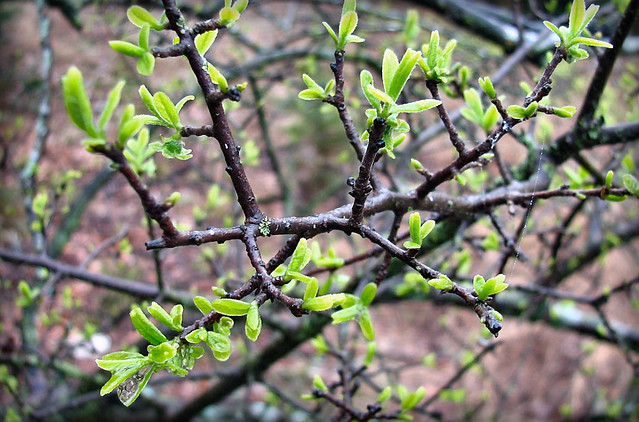
Ostara is the quickening time.  We feel the anticipation of the growing light rise within us, just as the sap rises in the trees.  The wheel of the year turns again, and we are at Spring Equinox, as all of nature celebrates the mystery of Rebirth.  Buds are bursting from their casements; birds awaken us with their courting music; and there is an undeniable feeling of unfurling optimism deep within the very rhythm of life itself.

 Ostara is the Anglo-Saxon Teutonic Goddess of spring, rebirth, and the dawn; she is also a potent symbol of fertility in her aspect as the Maiden in the Triple Goddess. Although there is little archeological evidence left behind of Ostara, we do find her mentioned by the Venerable Saint Bede, (672-735 C.E.) in his 8th century work, De Temporum Ratione, where he describes feast days held in her honor.  And, in his extensive study of German mythology and folklore Jacob Grimm, of Grimm’s Fairy Tales fame also attests to a Germanic Goddess by the name Ēostre.  It surely does not require too much of a stretch to imagine where the origins of another festival of rebirth that is celebrated at this time of the year gets its name.

Red eggs are an ancient symbol of fertility
Etymology aside, it is certain that Spring Equinox has been celebrated in many cultures since time immemorial as a fertility festival and as the rebirth of all life.  In ancient Greece, it is the time that Persephone rises from her long dark winter as the Queen of Hades, and is restored to her mother Demeter once again as the perennial Maiden. In her joy at being reunited with her daughter, Demeter the Earth Mother restores fertility and abundance to the land causing crops to grow and babies of all kinds to be born. In ancient Sumer/Babylon, spring is the time when Inanna/Ishtar makes her ascent from the Underworld and takes back her life and reclaims her power in the topside world. And, in the West Country of England, Ostara is known as Lady Day, a celebration of the Goddess and the reawakening of the land. 

Because light and dark are equal at this time, in many ancient/modern Pagan traditions, Spring Equinox marks the time when the God and Goddess are equal in strength, with the God gaining ascendancy as the light grows. In all of nature there is a frenzy of activity, and magical mysterious fertility dances of all kinds can be seen.

Glastonbury Tor in Spring
Because all of life is interconnected, we too feel the resurgence of energy, the delicious exhale after the constriction of winter’s darkness. Now is the time to make new beginnings, to cast off any remaining hindrances that might be holding us back.  As all of nature is in the throes of new growth, now is the time to tap into and embrace the flow and make changes for our own personal growth as well.  This includes not only changes on a spiritual or inner level, but in the outer world as well.  Remember, spring is the time when Persephone and Ishtar rise from the Underworld to be fully manifested in the upper world in all their colorful glory. Imbolc was the time we planted the seeds within, nurturing them through the last of the winter.  Now the tiny shoots and buds are opening, dazzling us with their brilliant colors and myriad beauty.


Monday, January 10, 2011

Imbolc: Harbinger of Spring


Yule has come and gone, and on this beautiful blue and white day, with the mountains dusted in the pink snow of the setting sun, I could swear I am already noticing the days getting longer. The ancient Celtic festival of Imbolc (February 2nd) is nearly upon us, as once again the wheel turns inexorably towards the light half of the year.  Imbolc is an ancient Irish word that translates roughly to "ewe's milk", and signaled the beginning of spring and the much anticipated event of the new lambing season; the rebirth of nature and indeed, of all life.  The highly recommended book,  The Winter Solstice: the Sacred Traditions of Christmas, explains that the people of the old world did not have fresh milk to drink for the entire winter, as sheep and cows only lactate after giving birth (Matthews).  Imbolc is a cross quarter festival midway between Winter Solstice and the Spring Equinox, and is a holyday sacred to the ancient Irish Goddess Brigit. 

Offerings at Brigit's Well - Kildare, Ireland
Brigit is a triple Goddess and on Imbolc she is associated with the aspect of the Maiden.  She is called on for inspiration, and is the patroness of poets, artists, and craftswomen.  Brigit is also known for her compassion for those less fortunate.  She was so beloved by the Irish people that when Christianity took over the old ways, she was thinly disguised as "Saint Brigit" (or Bride) and her veneration continues to this day at her monastery in Kildare, Ireland, where nuns tend her sacred flame.  Pilgrims from all over the world still come here and make their offerings and prayers at her sacred well.  

Incidentally, a book well worth seeking out, Confessions of a Pagan Nun, by Kate Horsley, is a riveting account written by a woman in 500 AD, and translated into readable modern English.  At the bottom of a well, about two kilometers from the monastery of Saint Brigit, a clay and iron box was excavated in which was discovered an almost perfectly intact number of scrolls wrapped in pigskin.  Almost the entire group of documents is written in the author's native Gaelic, so as to protect it from the ever watchful eyes of the Christian clergy.  It is a stunning account of the woman's early pagan life at a time when the danger of being named a heretic was a serious threat.  Highly recommended!


Imbolc/Chrysalis - Danielle Blackwood, 2003
Imbolc is the harbinger of spring. It is a time of renewed hope, and increasing optimism as the days grow visibly longer, and the sunlight begins to warm the earth once again.  We must remember that growth and transformation occur first in the dark, in the unconscious.  Much can be going on beneath the surface that we are not, as of yet, consciously aware of.  Like a seed germinating beneath the still frozen earth, the psyche’s process of initiation begins almost imperceptibly.  Watch for tiny shoots of inspiration, unfurling in the conscious mind. Those first stirrings are the promise of new things to come. The skull, an important symbol in Celtic mythology suggests ancestral wisdom and that all new life springs from the roots of what has come before. All life is connected. No one stands alone.  We have the ability to draw on the wisdom of those who have loved, struggled and made the journey before us.
 Happy Imbolc!